


 Price:

Characterize the detergent before selecting the dosing arrangement
Provide a sealed sample from the intended production lot and record apparent density, particle-size range, fines, moisture sensitivity and any perfume or coloured speckles. A dense compact powder and an aerated light powder can occupy very different volumes at the same mass. Run the material after normal warehouse conditioning rather than using only a freshly opened, unusually dry sample.
| Detergent condition | Likely packaging effect | Evidence to keep |
|---|---|---|
| High fines content | Dust can settle on film and create channels through a seal. | Seal-face photos after a sustained run |
| Variable bulk density | A volumetric setting can drift in mass between lots. | Individual weights linked to product lot |
| Moisture pickup | Bridging or delayed discharge can appear after exposure. | Timed open-product trial and hopper observations |
| Perfume or coloured speckles | Segregation can make consecutive packs look inconsistent. | Start, middle and low-level retained samples |
Separate mass accuracy from hopper flow
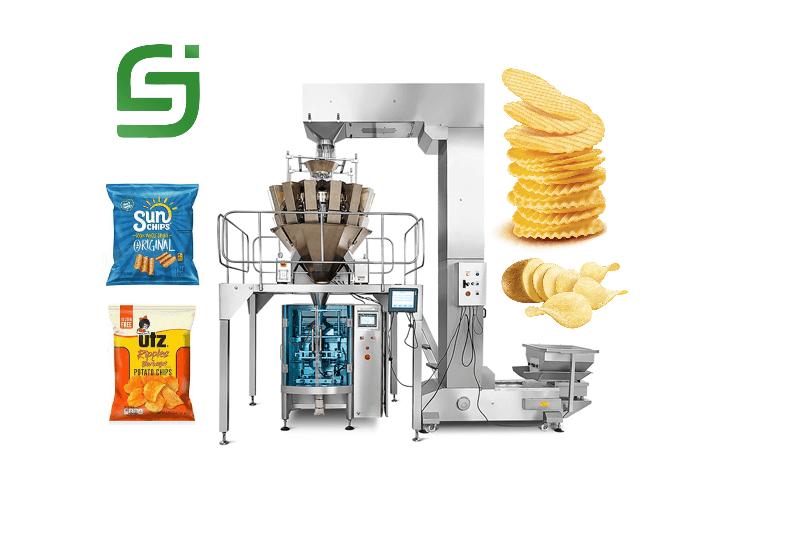
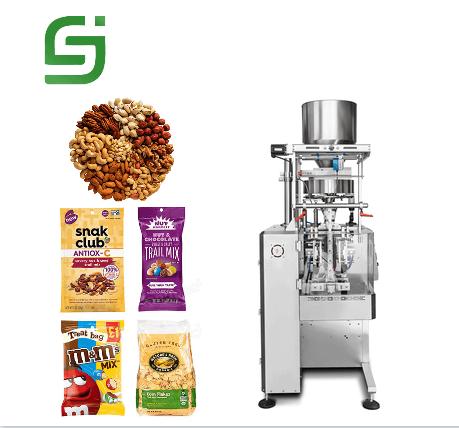
The saved range is 100-1000 g and the machine imagery shows a top-mounted feeding and measuring assembly. The exact fitted device must be named in the quotation. Collect consecutive pack weights at startup, stable operation, hopper refill, low level and restart. Report mean, spread and outliers by phase; a combined average can hide a bridge followed by a heavy release.
Observe the material above the measuring point as carefully as the finished pack. Record manual intervention, wall buildup, delayed discharge and powder left on horizontal surfaces. A setting is useful only when the feeder can reproduce it without frequent tapping or unrecorded operator correction.
Resolve the roll-film and prefabricated-bag descriptions
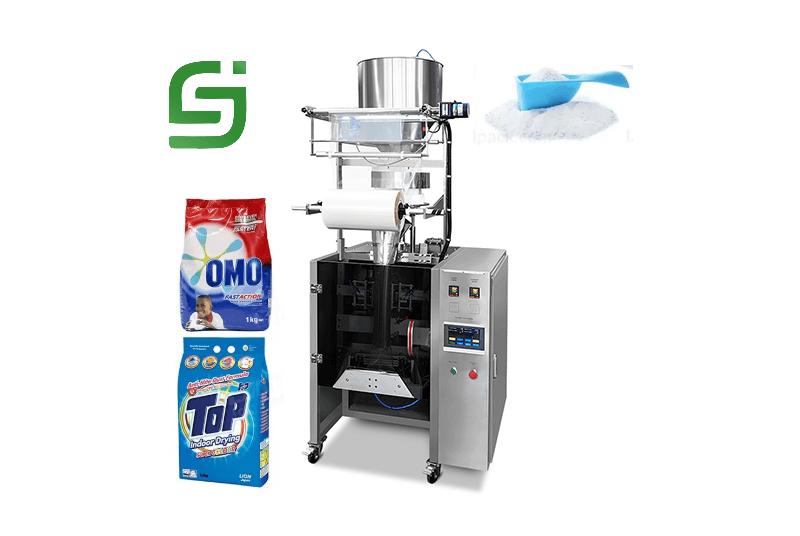
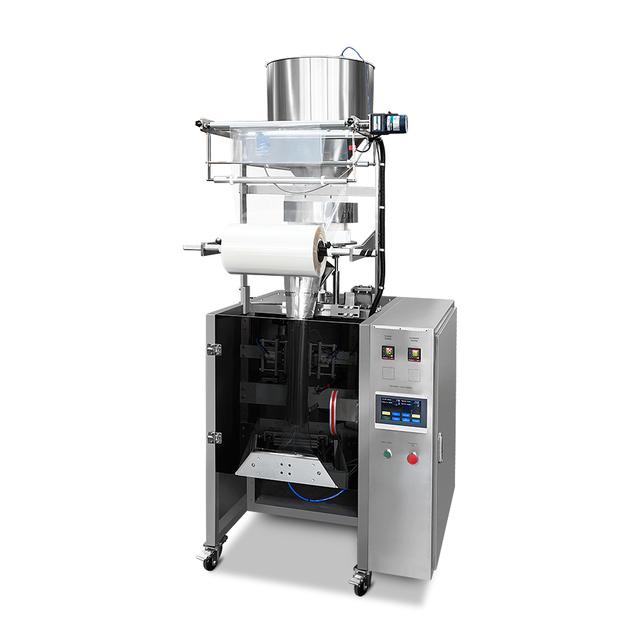
The product fields call the material prefabricated bags, while the technical table describes packaging film and back or three-side sealing. The machine photographs appear consistent with a vertical roll-film path, but an image is not enough to overrule stored text. The order should identify whether the delivered system forms bags from a web or handles a premade pouch, then name the laminate, roll direction or pouch dimensions, sealing pattern and coding zone.
Dust control is part of seal acceptance
Inspect the transition from dosing outlet to forming area and note where fine powder becomes airborne. Check the web shoulders, vertical seal and transverse jaws after the line has reached a dusty steady state. Open retained seals and classify trapped powder, wrinkles, channels and incomplete fusion. Cleaning frequency should be agreed from this run rather than estimated from a spotless startup demonstration.
Bag dimensions need a physical drawing and headspace rule
The stored window lists 40-250 mm length and 40-200 mm width. Those limits do not prove that every size runs with one former or the same film. Approve each commercial pack with finished dimensions, seal allowance, fill height, print repeat and film thickness. Confirm which width change needs mechanical parts and how much product headspace is required to keep powder away from the closing seal.
Keep consecutive individual weights from every defined operating phase.
Record visible escape points, cleanup frequency and seal contamination.
Use the production laminate and inspect registration, wrinkles and sealed samples.
Isolate the first packs after a routine stop without special preparation.
Do not turn the disputed speed into accepted output
One summary field states 10-30 bags per minute and the table states 15-30. Keep both outside the acceptance promise until the source record is reconciled. During testing, report set cycles and accepted packs separately. Deduct weight failures, dusty seals, poor registration, bad cuts and unreadable codes. The useful result is the sustained accepted count for the named powder and package.
Cleaning should prevent old detergent entering the next lot
Map residue in the hopper, dosing parts, discharge tube, former and guard ledges. Define safe emptying, permitted cleaning tools, inspection points and the first pack released after reassembly. Fragranced products need a carryover rule, especially when the next SKU is lightly scented or uncoloured. Keep photographs of the cleaned path with the approved setup record.
Questions for a washing-powder factory trial
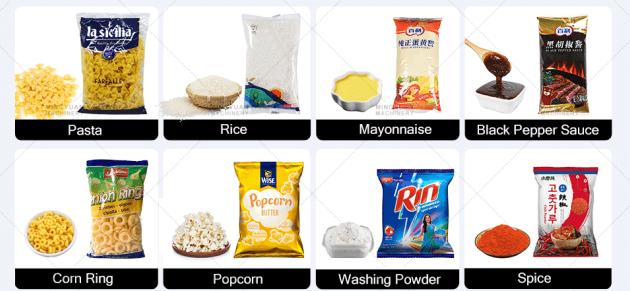
Can rice be used to prove detergent performance?
No. It does not reproduce detergent density shifts, fines, fragrance segregation or seal contamination.
Is the machine a roll-film or premade-pouch system?
The stored records conflict, so the final quotation and physical trial must identify the process.
Which speed range is valid?
The 10-30 and 15-30 records must be reconciled before either is guaranteed.
What is a meaningful seal test?
Inspect packs made after sustained dusty operation and retain opened seal samples.
Why sample at low hopper level?
Flow and segregation can change as the product inventory falls.
Conclusion
Approve the YS-80K around one detergent lot, a named dosing arrangement, a signed pack drawing, phase-separated weight data and dust-exposed seal samples. The related granule packing machine category provides context, while bag process and speed remain outside the guarantee until the source conflicts are resolved.



 Tel: +8617350750975
 Email: info@vffspackingmachinery.com
 MP/WhatsApp: +8617350750975
 Manufacturer Address:Meixi Road, Tongan District, Xiamen,Fujian,China