

Hot Keyword:
Author:YISEN Pouch Packing Machine Manufacturer TIME:2024-11-03
Packaging a sticky sauce is a controlled fluid-handling problem as much as a pouch-forming problem. Viscosity, temperature, particles, stringing, product supply, nozzle motion, and seal contamination all influence the finished pack. A well-matched line improves quality by delivering a repeatable portion, cutting off the product cleanly, protecting the closure area, and maintaining those conditions through startup, refill, pauses, and sanitation.
“Thick” is not a complete specification. Record viscosity or a practical flow measurement at the temperature and shear history used in production. Some sauces thin while being pumped, then recover in the pouch. Others become much more viscous as they cool. Emulsions may separate under excessive shear, and starch-based products can change consistency with residence time.
List suspended pieces by normal and maximum dimensions, concentration, fragility, and tendency to settle or float. Seeds, herbs, diced vegetables, meat particles, and fibers affect valve clearance and dose distribution. A smooth sample used for a demonstration cannot qualify equipment intended for a chunky recipe. Send representative batches from the real process, including expected variation.
Define product temperature at the filler inlet, allowed cooling, hold time, food-safety boundary, and cleaning method. Insulated or jacketed tanks, hoses, pumps, and nozzles may be needed to keep flow consistent. Heating should be controlled and reviewed with product specialists; excessive temperature can change flavor, texture, sealant performance, or operator risk.
A dosing pump performs consistently only when product arrives in a stable condition. Supply tanks need appropriate agitation or recirculation to prevent separation without incorporating air or breaking inclusions. Level control should coordinate the upstream feed with filler demand. A long narrow hose, high lift, sharp elbow, or undersized valve can create pressure loss and variable refill.
Positive-displacement pumps, lobe pumps, piston systems, and other designs have different effects on shear, particle passage, accuracy, and cleaning. The selected route should have openings larger than the largest inclusion with suitable margin. Dead legs and abrupt restrictions can trap solids, while air pockets compress and produce delayed discharge.
Watch the process during tank replenishment and after a pause. A new batch may enter at a different temperature or consistency. Product held in a heated line may become thinner, thicker, or separated. Sampling around these transitions identifies quality variation that an average result hides. Alarms should warn of low level, abnormal pressure, temperature deviation, and incomplete product recovery where applicable.
Piston fillers displace a set volume and can handle many viscous foods when cylinder, valve, and port geometry suit the sauce. Servo-driven pumps can provide programmable motion and recipe control. Other pump types may be suitable for specific textures or cleaning regimes. Volumetric repeatability does not guarantee net-weight consistency if density, temperature, entrained air, or particle distribution changes.
The fill profile can start quickly, slow near the end, and reverse slightly to reduce stringing. A shutoff or suck-back nozzle may create a cleaner cutoff, but excessive reverse motion can pull air or product residue into the tip. For chunky products, the closure mechanism must pass inclusions without crushing them or holding the valve partly open.
Evaluate ordered weights at startup, steady running, product replenishment, low tank level, after a planned stop, and during restart. Inspect inclusion distribution as well as total mass. If one pouch receives mostly liquid and the next receives concentrated solids, the average may look acceptable while consumer quality is poor. Record sauce temperature and batch condition with each sample group.
The pouch must be open wide enough for the nozzle to enter without wiping product onto the zipper or mouth. A diving nozzle can reduce splash by following the rising fill level, while a stationary tube may be adequate for slow, smooth discharge. The path should avoid scraping laminate or trapping a gusset. Position confirmation prevents filling when a pouch is missing, misgripped, or only partly open.
Nozzle diameter influences pressure, particle passage, and cutoff. A small outlet can accelerate product and increase stringing or shear; a very large outlet may be difficult to close cleanly. Tip geometry, surface finish, valve location, and distance from the pouch all matter. Place drip trays so they capture startup loss without interfering with bag handling.
Filling motion, settling time, and pouch transfer must allow the final strand or droplet to clear. A high empty-cycle speed is irrelevant if every production cycle leaves sauce on the closure area. Use guarded observation or video to tune the sequence, then confirm it over a sustained run as product warms or cools.
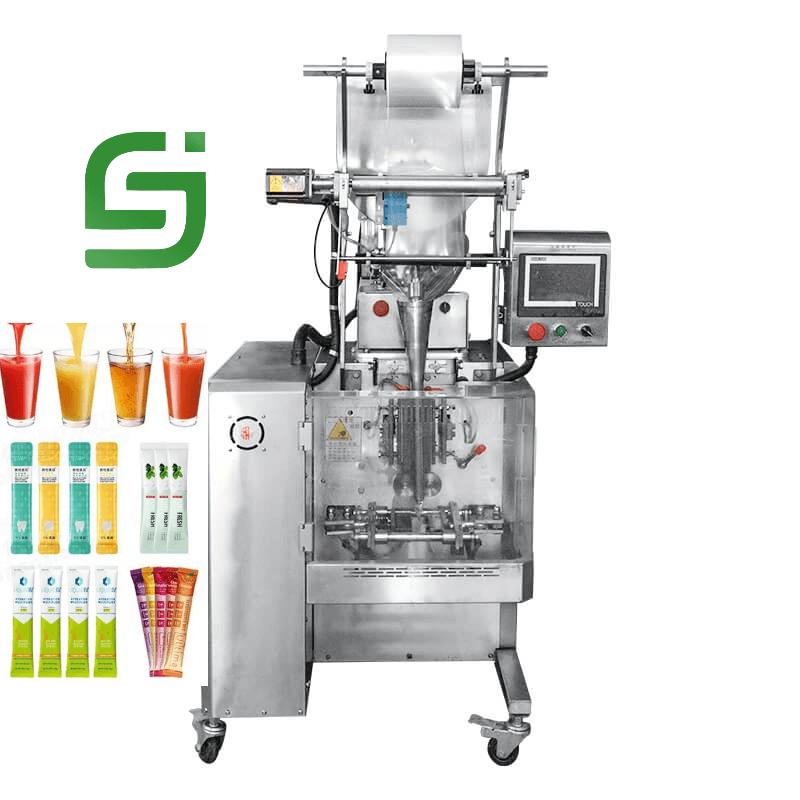
Oil, water, seasoning, or small particles in the top seal can form leak channels. The line may use mouth spreaders, controlled headspace, slower final dosing, wipe or vacuum features, zipper closing, and a preliminary seal to protect the area. These aids work only when matched to the residue. A wiping action can spread contamination rather than remove it if its contact surface is not maintained.
Heat sealing depends on laminate construction, jaw temperature, pressure, dwell, alignment, and cooling. Hot-filled sauce can transfer heat to the package and change the effective seal process. Pouch tension or overfilling may wrinkle the top. Jaws and protective tapes should be checked for buildup and local damage, with cleaning performed under approved isolation procedures.
Quality teams should define visual criteria and a physical integrity method appropriate to the package. Sample after warmup, during normal output, following pauses, and at the edges of the size range. Map defects by location. A repeated channel near the same nozzle side suggests a filling or positioning cause, while broad weak seals may indicate time, temperature, pressure, or material.
Package quality includes more than the absence of leaks. Check fill height, trapped air, pouch shape, contamination on the exterior, zipper usability, code readability, and whether inclusions are distributed as intended. A sauce smeared on the outside creates handling and hygiene problems even when the seal remains closed.
Where headspace gas or residual oxygen matters, specify the measurement method and sampling plan. Gas flushing effectiveness depends on pouch geometry, flow, timing, product displacement, and subsequent sealing. It should be demonstrated with actual sauce and package, not inferred from gas flow alone. Shelf-life claims require product and packaging validation outside the machine trial.
Use checkweighing or another suitable net-content control with secure rejects and reconciliation. Confirm tare variation for premade pouches. Establish what happens after a stop, nozzle drip, or uncertain fill signal. Packages affected by a fault should be held or rejected according to an explicit sequence rather than returned to sale based on appearance.
Sticky residue remains in tanks, pumps, valves, seals, hoses, manifolds, nozzles, drip trays, guards, and pouch grippers. Review every wetted part and product splash zone. The required cleaning approach may involve removal, manual wash, clean-in-place, sterilization, or a documented combination. Materials, gaskets, surface condition, drainage, and chemical compatibility need application-specific review.
Product recovery must stop before air or rinse water creates uncontrolled fills. Define how lines are emptied, how residual product is measured or discarded, and how the first packs after startup are released. Allergen or flavor changes may demand validated cleaning and separate soft parts. Hot product and cleaning fluids also require safe isolation, depressurization, and handling procedures.
Time a complete change from last acceptable pack to first released pack. Include cool-down, recovery, dismantling, washing, inspection, drying where required, reassembly, warmup, priming, and quality checks. A quoted tool-free disassembly time represents only one part of this production loss.
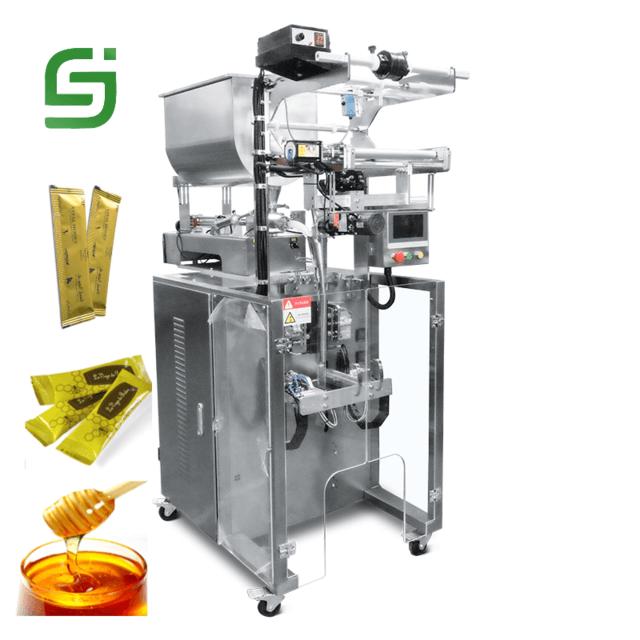
Provide the supplier with production sauce across expected viscosity, temperature, and particle extremes, plus approved pouches and fill targets. The sauce packaging machine configuration should be identified by tank, agitator, pump, valves, hose, nozzle, bag handling, sealing, coding, and inspection equipment. Run long enough to expose temperature drift, settling, buildup, refill effects, and routine cleaning needs.
| Trial condition | Quality question | Evidence to collect |
|---|---|---|
| Coldest approved sauce | Can the system fill without excessive pressure or tails? | Cycle data, weights, cutoff observations |
| Largest inclusions | Do valves pass pieces without blockage or damage? | Particle checks, stalls, distribution samples |
| Tank replenishment | Does temperature or density change the dose? | Ordered weights and product temperature |
| Planned production pause | Does retained sauce alter the restart? | First-pack condition, drip and seal results |
| Full sanitation cycle | Can contact zones be cleaned and released? | Time, inspection, residue or verification record |
Define acceptance in accepted packages per minute, weight distribution, seal results, exterior cleanliness, inclusion condition, code verification, and allowable interventions. Retain raw readings, rejected packs, defect photographs, recipe values, product batch data, and pouch lots. Repeat critical tests after installation using local utilities and trained operators.
Why does sticky sauce continue dripping after the dose ends?
Possible causes include unsuitable nozzle geometry, valve wear, excessive pressure, product stringing, trapped air, temperature change, or an ineffective cutoff profile.
Can the same pump fill smooth and chunky recipes?
Sometimes, but valve passages, particle size, shear sensitivity, cleaning, and accuracy must be proven with both products.
Does higher seal temperature fix sauce-contaminated seals?
Usually not. Contamination must be prevented or removed; extra heat can damage laminate while leaving a leak channel.
How should sauce weight accuracy be tested?
Use a verified scale and ordered samples through startup, stable running, refill, low level, pauses, and restart, with temperature recorded.
What samples are needed for a supplier trial?
Send representative sauce at process conditions, including worst-case viscosity and inclusions, plus approved pouches and enough quantity for sustained operation and cleaning.
Consistent sticky-product packs result from controlling the sauce before, during, and after dosing. Stable temperature and supply, suitable pump and valve geometry, a clean nozzle cutoff, protected pouch mouth, qualified sealing, and practical sanitation all contribute to package quality. A production-scale trial across realistic transitions establishes the operating range and gives buyers evidence for weight, appearance, integrity, maintainability, and accepted output.

YISEN MACHINERY - The ONE-STOP VFFS PACKING MACHINE SOLUTION SUPPLIER
 Tel: +8617350750975
 Email: info@vffspackingmachinery.com
 MP/WhatsApp: +8617350750975
 Manufacturer Address:Meixi Road, Tongan District, Xiamen,Fujian,China