

Hot Keyword:
Author:YISEN Pouch Packing Machine Manufacturer TIME:2026-09-08
Validate nylon or PLA mesh with the exact pyramid tea bag packaging machine configuration, tea blend, dose, and seal method. Material family names do not prove machinability; roll construction, friction, stretch, thermal response, cutting behavior, and supplier variation must be tested with retained evidence.
The buying question is not whether one mesh is universally better. It is whether a documented mesh specification forms a stable pyramid or selected bag shape, contains the intended tea, seals consistently, cuts cleanly, and supports the buyer's brewing and presentation requirements. Environmental claims also require separate, verifiable evidence and should not be inferred from the material name.
Planning note: Build the qualification plan before requesting a demonstration. Name the candidate mesh grades, production suppliers, tea blends, dose range, forming shape, target speed range, inspection methods, and decision owners. Send enough labeled material for setup, stable running, stop-and-restart checks, and retained samples; a short unmarked strip is not a representative trial supply. Agree how the team will record mesh waste, product waste, rejected bags, manual corrections, temperature stabilization, and roll changes. The buyer should also state whether the same line must alternate between mesh grades, because recipe access, cleaning, tooling inspection, and first-piece release then become part of the purchase decision. This preparation makes failed observations traceable to material, product, setup, or equipment rather than leaving the team with an unsupported conclusion about nylon or PLA as a whole. Name who can accept a conditional result, which corrective actions require another witnessed run, and how much commercial material must remain available for that retest. A signed exception should identify its production impact and expiry instead of becoming an undocumented permanent setting.
Acceptance note: Require the trial report to distinguish observations from conclusions. A photograph of a closed bag records appearance, while a released result also needs material identity, settings, product, run phase, inspection method, and sample disposition. When a candidate fails, document the failed criterion and whether a controlled adjustment corrected it. This discipline supports later supplier comparisons without turning one demonstration into a broad claim about every mesh of the same polymer family.
Record polymer family, mesh pattern, basis weight or thickness, width, supplier grade, surface treatment, color, roll core, winding, splice method, and allowed variation. Nylon and PLA labels cover many constructions that do not behave identically on a packaging line.
Working method: Obtain technical data and representative production rolls from the intended supplier. Measure several points across and along the web. Compare edge quality, flatness, stretch, friction, and visible defects before installing the roll.
Evidence to retain: Create an incoming specification with test methods and retain labeled samples from every approved lot used during qualification. Link those samples to the machine trial report.
Decision boundary: Do not substitute an unverified mesh because its sales description matches. The approved grade, supplier, and construction form the control basis.
Pyramid bag quality begins at unwind and web transport. A mesh that telescopes, curls, stretches unevenly, builds static, or tracks poorly can cause intermittent forming and sealing faults even if a hand-made sample appears acceptable.
Working method: Observe roll loading, braking or tension control, edge guidance, sensor response, and web contact surfaces. Run at low and intended speeds. Include a stop long enough to reveal heat or tension effects, then examine restart behavior.
Evidence to retain: Record tension settings, tracking corrections, roll diameter, ambient condition, static observations, and any manual adjustment. Photograph edge wandering or wrinkles with the corresponding machine state.
Decision boundary: A stable first few meters do not validate the roll. Review behavior as roll diameter changes and after a controlled stop or splice.
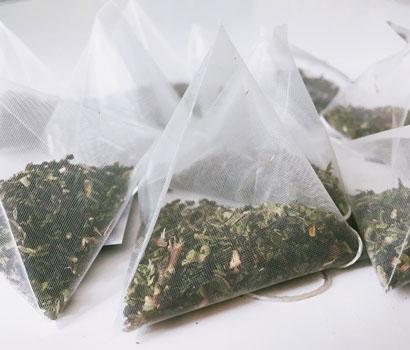
The mesh must fold or form around the selected geometry while leaving enough internal volume for the tea. Large leaves, stems, flowers, and mixed herbal components can bridge at the inlet, interfere with closure, or produce an uneven pyramid shape.
Working method: Test the actual product range at low, nominal, and high allowed doses. Inspect product drop, mesh tension, corner formation, headspace, trapped leaves, and finished dimensions. Include the blend most likely to bridge or spring back.
Evidence to retain: Retain formed bags from startup, stable production, refill, and restart. Record tea lot, sieve profile when available, target dose, measured dose, reject reason, and forming settings.
Decision boundary: A visually full bag may restrict movement or infusion and may contaminate a seal. Pack volume and presentation should be approved together.
Seal quality depends on material construction, temperature, pressure, dwell, tooling condition, web speed, and contamination. The useful output is an operating window with evidence, not one isolated setting that produced a few closed bags.
Working method: Run a planned matrix around the proposed settings while holding tea and geometry constant. Inspect continuous seal appearance, channels, thinning, distortion, holes, and product trapped at the closure. Challenge the line after warmup and a short stop.
Evidence to retain: Record settings and sample identity for every matrix point. Use the pyramid tea bag packaging machine configuration as the equipment reference, then retain accepted and failed seals for comparison.
Decision boundary: Do not publish unsupported seal-strength numbers. Use the buyer's defined inspection or functional test and document its method and condition.
| Decision area | Items to lock | Acceptance evidence |
|---|---|---|
| Roll handling | Width, winding, tension, tracking, static | Stable web path through roll-diameter change |
| Forming and filling | Geometry, tea profile, dose, headspace | Consistent shape without trapped product |
| Seal and cut | Operating window, tooling, edge condition | Released samples and defined defect limits |
| Supply control | Grade, lot, tolerances, notification | Incoming checks and retained material |
Mesh cutting can leave tails, fused edges, loose filaments, or deformation that affects appearance and handling. Cutter type, temperature where applicable, alignment, wear, and residue all influence the result.
Working method: Examine cut edges under consistent lighting and magnification suitable for the buyer's rule. Check consecutive bags, not only one sample. Review cutter behavior after warmup, after a stop, and near the end of the planned run.
Evidence to retain: Log edge defects separately from seal defects. Record cutter condition, cleaning, adjustment, replacement, and sample sequence so maintenance actions can be evaluated.
Decision boundary: An edge that looks acceptable in a photograph may still snag, shed, or open during use. Apply the agreed handling and brewing checks.
Machine acceptance establishes repeatable forming, filling, sealing, cutting, and presentation under stated conditions. Brewing evaluation addresses infusion flow, leaf expansion, taste protocol, bag integrity in hot water, and consumer handling. These are related but should not be confused.
Working method: Define a brewing method with water condition, time, handling, and sample count. Compare approved mesh candidates using the same tea and dose. Record bag opening, visible shedding, seam behavior, and leaf space alongside sensory or laboratory work owned by the buyer.
Evidence to retain: Keep machine trial data and brewing results linked by sample code. This allows a candidate to be rejected for the correct reason and prevents recipe adjustments from hiding a material problem.
Decision boundary: The equipment supplier should not make unverified taste, compostability, biodegradation, or food-compliance claims on the buyer's behalf.
A successful trial roll does not guarantee that later deliveries will match. The purchase specification needs tolerances and an incoming check that can detect changes in width, thickness, mesh pattern, surface, winding, or sealing behavior before production loss occurs.
Working method: Ask the converter or mesh supplier for change-notification rules, lot traceability, certificate fields, and sample retention. Compare more than one lot when risk and volume justify it. Define escalation for an out-of-limit roll.
Evidence to retain: Store incoming measurements, supplier documents, retained strips, machine release samples, and nonconformance records. Trend defects by lot instead of treating every stoppage as an operator issue.
Decision boundary: Supplier approval does not remove the need for receiving controls. Material construction can change while the commercial product name remains unchanged.
Once a mesh passes, preserve the complete configuration: machine revision, forming set, seal tooling, cutter, recipe, tea, dose, roll specification, environment, inspection rule, and released samples. This turns qualification into a reproducible production standard.
Working method: Restrict recipe access and identify who may approve changes. Require first-piece release after tooling work, recipe restoration, supplier change, or extended shutdown. Define a focused retest when width, structure, surface, roll construction, or product profile changes.
Evidence to retain: Back up recipes and maintain a change log with reason, approver, before-and-after settings, samples, and result. Include mesh-specific wear parts in the spare-parts review.
Decision boundary: Do not transfer settings automatically between nylon and PLA mesh or between grades. Each approved combination needs its own evidence.
Is PLA mesh always easier to seal than nylon mesh? No. Seal behavior depends on the exact construction, tooling, settings, speed, and contamination. Test each approved grade on the quoted machine.
Can empty mesh bags be used for acceptance? They are useful for setup but cannot replace filled trials because tea flow, trapped leaves, headspace, shape, and seal contamination affect results.
How many mesh lots should be tested? Use a risk-based plan. At minimum, retain the qualified lot; higher-volume or variable supplies may justify comparing multiple production lots.
Does the machine trial prove compostability? No. Environmental and disposal claims require separate evidence, standards, conditions, and market-specific review.
What should trigger mesh revalidation? Review supplier, grade, width, mesh construction, surface treatment, winding, splice, forming hardware, seal tooling, tea profile, dose, or recipe changes.
Validate nylon and PLA mesh as controlled material specifications, not generic names. A sound approval combines roll handling, product-specific forming, seal-window work, cutting inspection, brewing checks, supplier controls, and locked recipes. Preserve failed and accepted samples so future changes can be evaluated against evidence.

YISEN MACHINERY - The ONE-STOP VFFS PACKING MACHINE SOLUTION SUPPLIER
 Tel: +8617350750975
 Email: info@vffspackingmachinery.com
 MP/WhatsApp: +8617350750975
 Manufacturer Address:Meixi Road, Tongan District, Xiamen,Fujian,China