

Hot Keyword:
Author:YISEN Pouch Packing Machine Manufacturer TIME:2026-10-28
A Tea Bag Packaging Machine order should, subject to contract review, connect each fitted tea-contact part to its declared material, the evidence identifying that part, and the person responsible for unresolved questions. Include nonmetal contact pieces where present. A general stainless-steel description cannot establish the material of every installed surface or replace the buyer's qualified assessment of the intended use.
Begin with where loose tea travels in the offered configuration. Ask the supplier, within the documentation scope being negotiated, to identify the receiving surface, feed route, dosing assembly and final discharge into the inner bag. These are locations to investigate, not a claim that every model contains the same assemblies.
Distinguish surfaces that touch loose tea from framework, guards and equipment that handles an already enclosed bag. A stainless exterior does not identify the interior of a dosing component. Likewise, equipment beside the tea path should not enter the contact list solely because it appears in the same photograph.
Where contact is uncertain, mark the location for supplier clarification. An optional feeder deserves its own boundary if it is included in the order. A buyer-supplied upstream unit needs a named owner rather than disappearing between two suppliers' scopes.
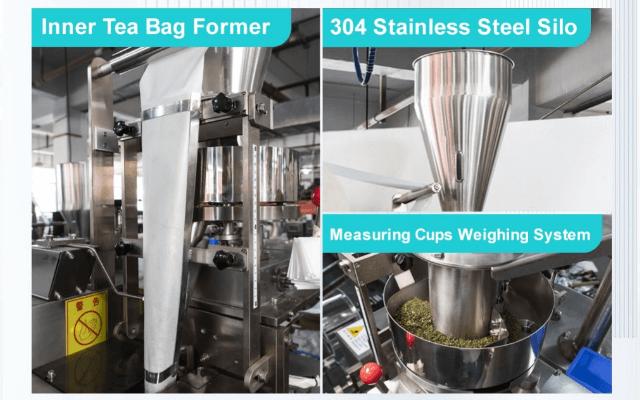
The official YS-169 page describes its material-contact parts as food-grade 304 stainless steel and separately identifies a 304 stainless-steel silo. These are supplier statements. The public page does not independently establish the alloy of an installed part, identify every contact item or provide traceability from a material record to a particular ordered machine.
The YS-66 page uses a broader description of stainless steel or food-grade materials. That wording does not establish a particular alloy for every surface. Nor should the more specific YS-169 wording be transferred to another model simply because both package tea.
When comparing the Tea Bag Packaging Machine range, turn those descriptions into configuration questions for contract review. Which parts does the statement cover? What material does the supplier declare for each? What supporting information is available? Neither page answers those questions for an individual order.
A useful contact-part register would let another reviewer locate the same component without relying on someone's memory. Subject to agreement, propose a part reference, station or location, drawing revision where available, declared material, evidence reference and review status. State which machine configuration the register describes.
If formal part numbers are unavailable, ask whether annotated views and consistent supplier identifiers can distinguish the items. Two similarly shaped funnels should not share an ambiguous entry if they occupy different locations or have different declarations. Photographs can establish location; they cannot establish alloy composition.
For an assembly with several exposed pieces, clarify whether the declaration covers the complete assembly or only its principal body. A hopper wall and a fitted outlet insert may need separate entries. Grouping is useful only when the shared declaration and physical boundary remain understandable.
For a coated or layered piece, if one is proposed, ask which surface actually faces the tea and what the declaration identifies. A description of the supporting metal may not describe its exposed layer. The register can preserve that distinction without assuming either the construction or its acceptability.
A statement about stainless steel can leave uncertainty around flexible connections, inserts, seals or other nonmetal items. Their presence and tea-contact role must first be confirmed for the offered build. Do not populate the register with imagined components or assign a polymer identity from appearance.
For any confirmed nonmetal contact piece, a possible contract request is its supplier identifier, declared material or grade, location and available supporting statement. A trade name alone may leave the reviewer unable to tell which construction is offered. If a component supplier holds the relevant information, agree who will obtain clarification.
Keep equipment pieces distinct from filter paper, mesh, thread and envelope stock. Packaging consumables raise separate specification and validation questions. Adding their supplier paperwork would not resolve an unidentified flexible component in the machine's loose-tea path.
The following examples illustrate how to review a proposed record. They are not statements about installed components or documents already supplied. Any requested information and resulting acceptance condition would need agreement during contract review.
| Part or location | Declared material | Evidence to discuss | Match to the build | Unresolved decision and owner |
|---|---|---|---|---|
| Tea hopper interior | 304 only if specifically declared | Statement identifying the hopper | Compare location and assembly revision | Supplier clarifies whether the outlet is covered |
| Fitted dosing contact piece | Not inferred from the hopper | Declaration for the named piece | Confirm the selected dosing arrangement | Supplier resolves an unidentified material |
| Nonmetal insert, if present | Exact declaration still needed | Available component information | Match identifier to the installed location | Supplier seeks details; buyer reviewer assesses relevance |
| Document naming an older part | Material may already be stated | Existing statement and revision explanation | Relationship to current part unresolved | Supplier explains the change before buyer review |
| Confirmed frame outside the tea path | Separate structural description | Boundary explanation if disputed | Confirm exclusion from tea contact | Technical reviewers resolve the contact classification |
A blank material field, an absent supporting statement and a statement referring to another part require different responses. Treating all three as missing paperwork can conceal the actual uncertainty.
Review a document by its connection to a register entry, not by its filename. Does it name the component, material, issuer and applicable revision? If it describes stock material rather than a finished assembly, what explanation connects that stock to the offered part? An impressive document bundle can still leave this relationship unanswered.
Ask for proportionate clarification through the agreed commercial scope. An existing supplier declaration may answer a narrow identity question; another question may remain unresolved. This is not a universal demand for particular certificates, laboratory work or a document package that the supplier has promised to provide.
For example, a statement might name the previous funnel revision while the quotation lists a revised outlet. That is initially a matching question, not proof that the material changed. Ask whether the revision affected the contact piece and whether the existing statement still applies. Preserve the explanation with the entry rather than relabeling the old document as current.
Keep material identity separate from intended use. The buyer's qualified reviewer needs the proposed tea products and relevant use conditions alongside the material information. Neither an identified alloy nor an available document automatically settles suitability. Record the reviewer's remaining questions without turning a material designation into an approved-alloy promise.
The intended-use description should distinguish the products planned for launch from later possibilities. If a flavored blend is only a future option, make that limit visible to the reviewer. A decision based on one described application should not expand silently because a sales discussion mentions additional tea recipes.
The supplier is the starting point for explaining what is offered, which parts are included and what materials it declares. The buyer's engineering reviewer can check whether the record describes the selected configuration. The buyer's qualified material or quality reviewer evaluates whether the available information answers the intended-use questions within their remit.
These responsibilities should be proposed and agreed, rather than presumed. Purchasing can coordinate an open-item list, but a commercial signature alone does not answer a technical material question. Likewise, an engineer confirming that a drawing matches the machine has not necessarily accepted the material for the buyer's application.
Distinguish an unknown material, missing evidence, a mismatched document and a pending assessment. For each unresolved item, propose an owner, the question to answer and the contractual decision affected. If evidence remains unavailable, seek an explicit disposition from the authorized buyer reviewer; do not silently convert uncertainty into acceptance.
Consider a part whose material declaration and identity match, but whose intended-use review is unfinished. Asking the supplier to resend the same file will not close that item. The next action belongs with the designated reviewer, unless that reviewer identifies a specific factual question for the supplier. Record that handoff clearly.

A replacement can fit mechanically while leaving its material relationship unexplained. During contract review, consider whether future orders should reference the contact-part identifier and accepted material declaration, alongside dimensions or assembly references. This is a proposed purchasing control, not a claim about included spare-part services.
If a supplier proposes a substitute, ask what changed: part construction, declared material, component source or available evidence. The buyer's designated reviewer can then decide what additional explanation is needed. An unchanged commercial description should not conceal a different contact piece.
Apply the same logic to optional assemblies added before delivery. If the feeding arrangement changes, revisit the affected contact entries. Keep unaffected entries intact so reviewers can see the specific change rather than reconstructing the entire dossier from a replacement brochure.
Before agreeing closeout terms, compare the offered configuration with the latest contact-part record, supporting references and outstanding questions. Separate information reviewed from information merely requested. If revisions are exchanged, identify which version forms the proposed order baseline and who has accepted its remaining conditions.
A useful final discussion asks whether every in-scope contact location has an understandable disposition, whether documents actually correspond to those parts, and whether unresolved intended-use questions have reached the responsible reviewer. Documentary completeness and application assessment are separate conclusions.
Negotiate any hold, clarification deadline or change-notification arrangement through the contract. This article does not establish legal compliance, require a particular certificate, or guarantee that a supplier will furnish every requested record. Its purpose is to make the buyer's material-evidence decision specific enough to review.
Does a 304 statement cover the complete machine? Its scope needs clarification. A statement naming one silo does not identify every fitted contact surface. Even broader wording needs a connection to the ordered configuration before the buyer can assess what it covers.
Can photographs replace material declarations? Images help reviewers recognize a location or distinguish assemblies. Appearance does not identify an alloy or nonmetal formulation. Use photographs as location references alongside the available declared material information.
What if the material is named but its evidence is unavailable? Keep the declaration and the evidence gap visible as separate facts. Ask the supplier what support exists, then refer the remaining uncertainty to the authorized buyer reviewer under the agreed contract process.
Should filter-mesh documents go into this equipment register? They can be cross-referenced in a wider purchasing file, but mesh qualification answers another question. It does not identify the materials of fitted dosing or transfer components that contact loose tea.
Who accepts a replacement contact part? Agree that responsibility during purchasing review. The supplier explains the replacement and any material change; the buyer's designated reviewer assesses the information required for that application. Mechanical fit alone does not close the material question.
The useful purchase record connects the tea-contact boundary, identifiable fitted pieces, supplier-declared materials and evidence that actually refers to those pieces. It also shows who owns each unanswered question. For this order, agree the requested information and acceptance responsibilities through contract review, preserve unresolved distinctions, and let qualified buyer assessment determine what the evidence supports for the intended use.

YISEN MACHINERY - The ONE-STOP VFFS PACKING MACHINE SOLUTION SUPPLIER
 Tel: +8617350750975
 Email: info@vffspackingmachinery.com
 MP/WhatsApp: +8617350750975
 Manufacturer Address:Meixi Road, Tongan District, Xiamen,Fujian,China