

Hot Keyword:

Author:YISEN Pouch Packing Machine Manufacturer TIME:2026-11-11
A bag dimension near its limit should be accepted according to an agreed rule that explains how measurement uncertainty affects the decision. For a tea bag packing machine, the drawing's permissible dimensions and the measured values that authorize acceptance are related but different. An inward guard band is one possible choice; simple acceptance can also be legitimate. Neither choice should be invented after the result is known.
Imagine that a buyer and supplier agree on the measured width of one identified finished envelope. They use the same requirement and understand the same measurement result. There is no dispute about which physical item was checked. They can nevertheless disagree about acceptance if one compares the reading directly with the drawing limit and the other applies a previously agreed inward acceptance limit.
That disagreement concerns interpretation, rather than two laboratories obtaining different values. Repeating the measurement does not define which rule governs. First establish whether the parties are using the same acceptance rule and the same treatment of uncertainty. A more detailed number cannot supply a missing agreement.
The YS-169 provides a concrete inner-bag and outer-envelope context for this question. Its control-panel photograph identifies the equipment reference; the visible screen values do not establish a measured dimension for an identified retained bag or decide whether it conforms.

A product requirement identifies permissible values of a property. Its dimensional limits belong to the specification of the bag. An acceptance interval identifies measured values that lead to acceptance under a stated rule. JCGM106 distinguishes these concepts because a measurement does not disclose the property with unlimited certainty.
Suppose an approved drawing gives an upper dimensional limit called L. Under simple acceptance, the corresponding upper acceptance limit coincides with L. Under guarded acceptance, the upper acceptance limit, called A here, sits inside that specification boundary. These letters describe a conceptual comparison, not a tolerance proposed for the YS-169 or any commercial tea bag.
The distinction matters when a measured result lies between A and L. It may satisfy the simple-acceptance condition while failing the guarded-acceptance condition. The product drawing has not changed. What differs is the rule for deciding from the measurement.
Do not treat catalog size ranges as the missing drawing limits. A machine's stated format capability does not supply the dimensional tolerance, measurement basis or acceptance rule for an ordered envelope.
A dimensional result needs more than the digits shown by an instrument. The international metrology vocabulary describes measurement uncertainty as characterizing the dispersion of values attributed to the quantity being measured, using the available information. Its components can arise from more than one source. Display resolution alone is therefore not a complete uncertainty statement.
The relevant information concerns the actual measurement method and object. NPL's guidance explains that contact force can deform soft materials and affect measurements. Applying that principle to a flexible tea bag is an engineering inference: support, contact and sample condition deserve attention. It is not a tea-specific measuring procedure or an instruction to choose a particular instrument or force.
For this acceptance question, assume that the intended dimension and method have already been defined. The task is to understand the uncertainty associated with that result and its role in the agreed decision. A competent reviewer must judge whether the information is adequate; this article supplies neither a calculated uncertainty budget nor a calibration method.
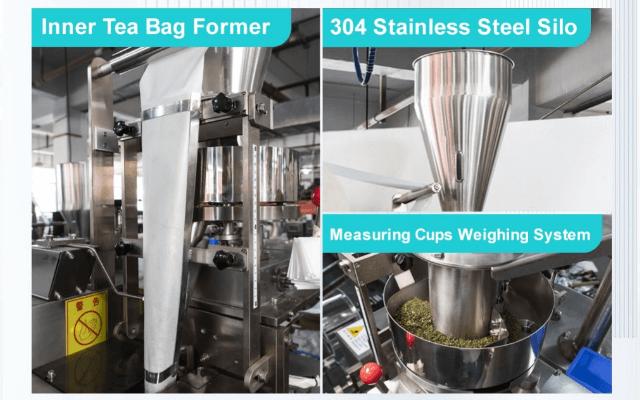
The YS-169 former and feed-area views help distinguish the inner-bag production context from the later envelope. Their printed material and weighing labels do not establish metallurgy, calibration or dimensional evidence.
Simple acceptance uses the specification interval as the interval of measured values that leads to acceptance. JCGM106 also describes it as a shared-risk approach. The parties accept the possibility of an incorrect decision associated with the measurement, rather than automatically moving the acceptance limits inward.
It would be misleading to call every such decision careless or invalid. The guide explains that the uncertainty normally needs to have been considered suitable for the intended purpose. A deliberately selected rule, supported by an adequate measurement method, is different from ignoring the subject because the instrument displays several decimal places.
The purchasing discussion should therefore establish what was agreed and why it is appropriate for this characteristic. If simple acceptance governs, do not add an undisclosed extra margin when a result becomes uncomfortable. Equally, a statement that the reading is inside the drawing limits is incomplete when the agreement explicitly calls for a different acceptance interval.
Consistency concerns the interpretation of evidence, not a promise that every result inside the interval reveals the true dimension exactly.
For an upper specification limit, guarded acceptance moves the acceptance limit inward. The interval between those corresponding limits is a guard band. In JCGM106's explanation, this arrangement reduces the risk of accepting an item that is actually nonconforming under the stated method and assumptions.
The inward shift should not be mistaken for a revised product design. It changes which measured values authorize acceptance; it does not silently reduce the nominal envelope size or require a different former. If the parties want to alter the bag specification itself, that is a separate decision.
Nor does the word guard band determine its width. The appropriate relationship to uncertainty and the consequences of an incorrect decision need qualified consideration. No universal margin, uncertainty multiplier or required coverage probability is prescribed here.
| Interpretation agreed in advance | Meaning of a near-limit reading | Conclusion to avoid |
|---|---|---|
| Simple acceptance with suitable measurement information | Compare the measured value with the specification interval | Assuming that the true dimension is known without uncertainty |
| Guarded acceptance with an inward limit | Compare the measured value with the stated acceptance interval | Changing the drawing to conceal the more restrictive decision boundary |
| No agreed treatment of uncertainty | The interpretation still requires resolution | Declaring a pass or failure by choosing a convenient rule afterward |
False acceptance means accepting an item that is nonconforming. False rejection means rejecting an item that is conforming. The uncertainty associated with measurement makes both possible; the measured value and the unknown property are not interchangeable.
An inward acceptance boundary emphasizes reducing false acceptance. That choice can increase the other kind of risk. It is therefore a tradeoff, not a free improvement created by adding a margin. The responsible parties need to consider the consequences for this characteristic and the information available about the measurement.
A bag whose reading fails the guarded-acceptance condition has not thereby been proved to have a true dimension outside the drawing limits. It has failed the criterion used to authorize acceptance. That distinction is particularly useful when a result remains inside the product tolerance but outside the more restrictive acceptance interval.
Avoid attaching a numerical probability to these statements without the required model and information. The source's illustrative distributions and risk figures cannot be transferred to an unmeasured tea-bag application. Choosing a rule does not produce those missing facts.
An acceptance statement must retain its object and characteristic. Inner filter-bag width, completed-envelope width and a dimension inferred from a machine setting are different things. An agreement about one measured characteristic cannot be used to declare every stage dimensionally acceptable.
This does not require another general bag-measuring checklist. It requires the decision to remain attached to the dimension that was defined. For example, an envelope-width decision needs an envelope-width result, its relevant uncertainty information and the rule governing that result. A screen entry or a former photograph does not take the place of that measurement.
The discharge photograph locates the downstream pack context on the YS-169 reference. It does not identify calibrated specimens or demonstrate that the pictured pouches passed dimensional inspection. A bag present on a conveyor is not a dimensional acceptance result.
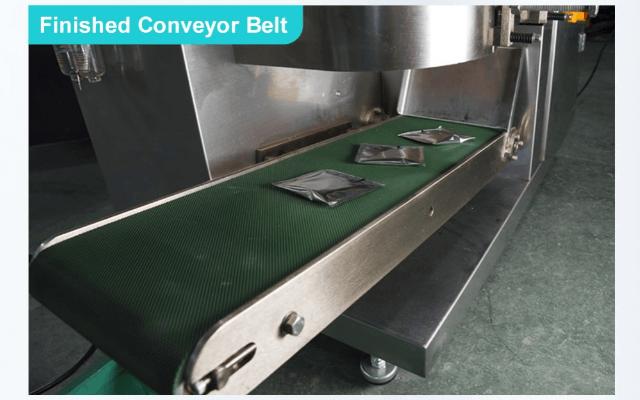
Even an appropriately accepted dimension settles only that characteristic under its stated scope. It does not establish seal integrity, the correctness of every other dimension or the proportion of future bags that will conform.
When a result does not support an agreed disposition, identify the missing element. It may be the governing acceptance rule, the uncertainty information or the link between the stated dimension and the reported measurement. Those gaps call for different clarification; another production run is not automatically the answer.
Further measurement may be appropriate when qualified reviewers identify a meaningful improvement in the method or its information. Repeatedly checking until a favorable reading appears does not explain the original uncertainty or establish a consistent rule. Preserve the earlier result and identify what any new work is meant to resolve.
Keep a proposed change to the product specification separate from clarification of its acceptance rule. Relaxing a drawing limit after seeing an awkward result is a different commercial decision, and should never be hidden as a correction to metrology.
For the same reason, do not attribute a borderline outcome immediately to a machine fault. First determine what conclusion the measurement supports. Only then can the responsible parties decide whether a product or process question remains.
A useful dimensional conclusion names the characteristic, the reported result, the relevant uncertainty information and the acceptance rule applied. Keeping those elements together allows a later reviewer to understand why the result received its disposition.
For a tea bag packing machine purchase, that is more informative than a bare tick beside bag size. If the specified property, measurement method or uncertainty information changes, review whether the earlier interpretation still applies. Do not extend an accepted inner-bag dimension automatically to a different outer envelope.
Where the available evidence remains inadequate, record the dimensional conclusion as unresolved rather than manufacturing a pass from the nearest screen value. An honest open result preserves the question that the next piece of evidence must answer.
Can a dimension inside the drawing limits remain unaccepted? Yes, if the agreed acceptance interval is more restrictive. The reading may satisfy simple acceptance but not the selected guarded-acceptance condition. Identify the governing rule before assigning a disposition.
Must every tea-bag measurement use a guard band? No universal requirement is established here. Simple acceptance can be deliberate and legitimate when the measurement information is suitable for the purpose and the parties understand the chosen rule.
Does failing guarded acceptance prove the bag is physically outside tolerance? It means the measured result did not satisfy that acceptance criterion. The unknown property and measured value remain distinct; an unfavorable disposition is not unlimited knowledge of the true dimension.
Will a finer instrument display settle a boundary question? Additional display digits do not establish the complete uncertainty of the actual method. Nor do they determine the acceptance rule. The relevant measurement information and agreed interpretation still matter.
What if buyer and supplier agree on the reading but disagree on the outcome? Compare their acceptance rules and treatment of uncertainty. Agreement on a measured value does not establish agreement on which values authorize acceptance. Resolve that distinction without inventing a new product tolerance.
A borderline bag dimension makes the acceptance agreement visible. The product tolerance describes the required property; the acceptance interval describes which measured results justify a disposition. Simple acceptance and an inward guard band distribute decision risks differently. Choose and explain the applicable rule with suitable measurement information, then apply it consistently to the defined bag characteristic. The resulting conclusion should preserve that reasoning, including any uncertainty that prevents closure.

YISEN MACHINERY - The ONE-STOP VFFS PACKING MACHINE SOLUTION SUPPLIER
 Tel: +8617350750975
 Email: info@vffspackingmachinery.com
 MP/WhatsApp: +8617350750975
 Manufacturer Address:Meixi Road, Tongan District, Xiamen,Fujian,China