

Hot Keyword:
Author:YISEN Pouch Packing Machine Manufacturer TIME:2026-11-16
A positive-displacement feed pump needs an engineered answer to blocked discharge; a stopped pouch cycle alone does not supply that answer. When buying a honey packaging machine with an external pumping circuit, identify the pressure boundary, the protective function and the route taken by relieved product. An open receiving hopper, an ordinary flow-control valve and a pressure-protection assembly have different jobs.
Begin with the equipment boundary. Some honey packers receive product in an open hopper; others are connected to separately supplied transfer equipment. A photograph of a vessel above a filler does not identify the upstream pump, prove a pressurized supply or show which company designed the connecting circuit. Those are separate items in the machinery purchase.
Also distinguish a dosing assembly from a transfer pump. The dosing assembly portions honey for an individual pack. A transfer pump supplies the receiving system from another vessel or process. The two functions may be coordinated, but the presence of one does not establish the other. A statement that the machine uses positive displacement needs to identify the component concerned.
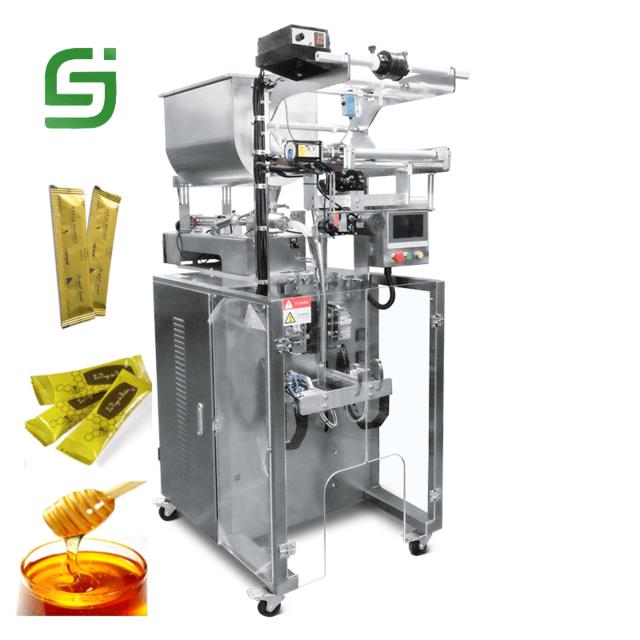
The honey-stick product overview shows a rectangular receiving hopper and the packing platform. Use it to locate the product inlet in discussion, rather than to infer hidden pumping equipment. If the offer includes a positive-displacement transfer unit, request its exact identity and circuit scope. If no such unit is supplied, retain that exclusion instead of inventing one from the application name.
A positive-displacement pump moves product from its inlet toward its discharge as its mechanism turns. Viking's technical manual explains the consequence when that delivered product has no available outlet: pressure can continue building until something limits the drive or a component fails. The hydraulic question therefore persists even when a downstream device has stopped requesting honey.
For a purchase review, distinguish a pump command from a confirmed condition of the complete circuit. The bag-making section may stop while other equipment has its own controls. A receiving valve can close for reasons unrelated to the transfer pump. Neither a shared emergency-stop symbol nor a description of automatic feeding explains every possible relationship between those components.
This does not mean that every honey packer has a blocked-discharge hazard of the same form. It means the proposed supply architecture needs an explicit explanation of where displaced product can go. The explanation belongs with the responsible equipment designer. It should address the actual pump and receiving arrangement, rather than rely on the assumption that normal production always keeps an outlet available.
A pressure boundary is a physical part of the product route, not an outline around the machine cabinet. Identify the pump discharge, connecting components and the point at which honey reaches the receiving arrangement. A motor and a hopper can be visible while intermediate hoses, valves and branches remain absent from a sales photograph. Those missing connections may determine the engineering responsibility.
The open vertical hopper in the source image illustrates an important distinction: receiving product in an open vessel is not the same as containing product in a closed pressurized circuit. The photograph provides no vessel pressure rating and no evidence of a relief device. Do not attribute the upstream line's protection to the hopper simply because both belong to honey feeding.
Have the designer identify which parts can be exposed to the proposed supply conditions and which documents establish their suitability. That review should include purchased connecting parts as well as the major assemblies. A pump specification cannot, on its own, establish the suitability of a hose or a receiving connection supplied by someone else. The complete boundary must have an owner.

Normal control governs the intended movement of honey during production. It may respond to a receiving level, a filling request or another process condition. Pressure protection addresses a different question: what limits an unacceptable pressure condition when the ordinary route does not behave as intended? The two functions can interact, but their purposes should remain distinguishable in the offer.
Viking specifically distinguishes its relief function from routine pressure or flow regulation. That warning is useful when evaluating a description that treats bypassing product as the normal way to control supply. Ask the designer to identify the intended operating function and the protective function separately. A component with a similar-looking valve body does not settle which job it is designed to perform.
A pressure sensor observes a location; an alarm interprets a signal; a drive command requests a change in pump motion. A relief path provides somewhere for displaced product to go under its designed condition. These are distinct physical and control functions. Listing all four without describing their relationship leaves the protective architecture unresolved, even when the machine screen looks comprehensive.
A relief description is incomplete without a destination. The Viking manual distinguishes an internal arrangement returning flow toward the pump inlet from an arrangement returning it to the supply tank. Both involve an alternate route, but they do not describe the same equipment boundary. A compact pump assembly and a return circuit extending through the plant need different scope descriptions.
The manual also explains that its spring-loaded relief design responds to the difference between pressures on its two sides. The return side is therefore part of the hydraulic explanation, not an irrelevant drain connection. A statement about one pressure value cannot replace identification of both sides and their intended destinations. This describes the design question without supplying an adjustment value.
Product identity matters as well. Returning honey to a vessel is not merely a geometric detail when that vessel can contain another batch or be assigned to a different production state. The producer decides the permitted product disposition; the engineering team must make the intended destination unambiguous. This is not a reason to prescribe a universal return arrangement, but to ensure that the proposed one is actually described.
A protective path must be understood in relation to the other valves and branches in the circuit. A relief component drawn near a pump does not prove that every possible line configuration keeps it connected to the boundary it is supposed to protect. Its location and the surrounding isolation arrangement therefore belong in the engineering review.
The manufacturer's pump documentation explicitly addresses this topology. For the buyer, the appropriate question is which permitted configurations the supplier has considered and who controls changes to them. Do not reduce the review to counting relief symbols on a drawing. One symbol can represent a well-defined function or an incomplete arrangement, depending on how the circuit is connected.
Think of the drawing as connected product volumes rather than a collection of symbols. A branch can remain connected to the pump while another section becomes separated; protection assigned to one volume does not automatically establish protection of every other volume. Later additions can change that connectivity without changing the pump. The supplied engineering description should identify the volumes and configurations covered, without leaving the purchaser to invent valve-position instructions.
If a transfer system is intended to operate in more than one direction, the pressure-protection question follows that duty. The discharge side in one direction is not automatically the same physical connection in the opposite direction. Viking's manual treats reversible service as a distinct case requiring protection appropriate to the directions concerned.
Reversal should therefore be stated as an intended operating function, not assumed from the presence of a reversible drive. A motor's ability to turn the other way does not establish that the pump, seals, valves, protective arrangement and receiving equipment form an approved reverse-transfer system. The purchase commitment concerns the complete function, not one electrical capability.
Where reverse transfer is outside the offered scope, record that boundary clearly. Where it is included, obtain the supplier's engineering description for that duty before accepting a generic pump package. The source material supports asking the directional question; it does not justify telling operators how to reverse equipment or reposition protective components. Those decisions remain specific to the supplied system.
Food handling adds requirements beyond the basic pressure function. Alfa Laval's safety-valve leaflet provides an example of a hygienic spring-loaded relief assembly and describes how its opening relates to a configured pressure condition. It demonstrates that hygienic protective components exist, but does not identify the suitable component or setting for a particular honey line.
The engineering purchase needs both functions addressed: appropriate protection and a product-contact arrangement compatible with the producer's hygiene program. A valve selected for one duty cannot be accepted for the other merely because its exterior is stainless steel. The exact wetted construction, connections and cleaning arrangement should be identified by the supplying parties.
Keep cleaning access and pressure review connected without making them interchangeable. An accessible valve can still have an unsuitable protective application; a correctly selected protective component can still be poorly integrated into the intended sanitation method. The buyer needs the complete assembly and its documented application, rather than a generic food-grade label or an industrial-pump example treated as a honey equipment endorsement.
A split purchase is common enough to deserve an explicit interface: the packer supplier may provide the hopper and dosing equipment while another party supplies transfer. Specify who designs the pressure boundary and who reviews the connection between those packages. Otherwise each quotation can appear complete within its own enclosure while leaving the connecting circuit undefined.
Compare the proposed honey-compatible packing equipment by its actual receiving arrangement, then assign the additional feed functions separately. The portion-pack artwork provides commercial-format context. It establishes no protective hardware, tested operating condition or supplier responsibility for an external pumping installation.
| Proposed arrangement | Boundary to establish | Responsibility to resolve |
|---|---|---|
| Open gravity receiving hopper | Receiving vessel and dosing inlet | Actual supply method |
| Positive-displacement transfer | Pump discharge and connecting route | Engineered pressure protection |
| External return circuit | Return pipe and destination | Complete return assembly |
| Reversible transfer duty | Each intended flow direction | Reviewed directional protection |

Does every honey packer need the same relief valve? No. First identify whether a positive-displacement feed pump and a relevant closed circuit are part of the proposal. Component choice follows that application; an open hopper photograph does not establish it.
Does stopping pouch production prove that transfer has stopped? No. Separate equipment can have separate controls. The delivered interface must explain the relationship between packer demand, receiving conditions and the upstream pumping function.
Can the relief device be assumed to control ordinary supply? No. Routine flow regulation and pressure protection answer different questions. The pump supplier should identify the intended protective function rather than relying on an unexplained bypass description.
Are an internal return and a tank return equivalent purchases? They have different physical scopes. The latter includes a destination and connecting route outside the pump. Identify those parts and their responsibilities instead of comparing only the valve name.
Should the buyer demonstrate protection by blocking discharge? No improvised blockage test follows from this review. Obtain the designer's documented basis and any professionally defined verification arrangement appropriate to the supplied equipment.
Pressure protection belongs to the actual honey supply circuit. Identify the pump, trace the boundary it can pressurize, and establish the protective function and product destination. Keep normal regulation, open receiving vessels and pressure containment distinct. When transfer and packing equipment come from different suppliers, a named owner for their connecting design is more useful than an assumed safeguard hidden behind the word automatic.

YISEN MACHINERY - The ONE-STOP VFFS PACKING MACHINE SOLUTION SUPPLIER
 Tel: +8617350750975
 Email: info@vffspackingmachinery.com
 MP/WhatsApp: +8617350750975
 Manufacturer Address:Meixi Road, Tongan District, Xiamen,Fujian,China