

Hot Keyword:
Author:YISEN Pouch Packing Machine Manufacturer TIME:2026-10-12
Specify filter rolls against the actual unwind assembly of the Tea Bag Packing Machine: core bore, usable core width, winding direction, web width, outside diameter and loaded mass. Put these requirements on an approved mechanical drawing with tolerances and receiving checks. A filter material name or finished-bag dimension cannot establish that a purchased roll will fit.
A common purchasing gap sits between two documents. The machine quotation names a filter material, while the converter's quotation describes a roll for tea bags. Neither may identify the physical connection between the delivered core and the installed holder. Resolve that connection before ordering a production quantity.
Ask the machine supplier for a revision-controlled unwind interface drawing. It should identify the holder, support and locating surfaces, permissible roll envelope, loading orientation and relevant access restrictions. The converter should return a roll drawing that references the same interface. Have both parties resolve mismatched terminology instead of allowing purchasing to infer a fit.
The official tea pages describe different packing arrangements, including pyramid, inner-and-outer and round formats. That variety is a reason to request configuration-specific information. The Tea Bag Packing Machine range provides a starting point; it does not supply a common core specification for every arrangement.
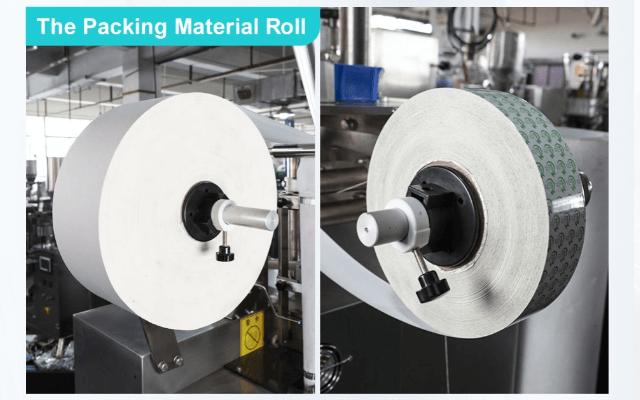
Core bore is the internal opening that mates with the specified holder. Usable core width is the axial length available for the agreed support and location method. Web width is a third dimension. These measurements can differ when the core projects beyond the material or when the holder needs an exposed end.
Request nominal values and permitted variation for bore, core length, end projection and the positions used to locate the web. Ask whether the approved interface relies on end faces, a stop, clamping surfaces or another arrangement. The drawing should show which surfaces carry or locate the roll; a statement that the core fits on the shaft is incomplete.
Include core condition in the discussion. A bore may measure acceptably at one end while an oval, crushed or damaged region prevents proper mounting. Ask the supplier to define a receiving measurement method and rejection conditions suitable for the approved core construction. Do not authorize an improvised spacer or replacement core merely because a trial roll can be made to sit on the holder.
Clockwise and counterclockwise mean little without a viewing direction. Establish the end from which the roll is viewed, the position of the departing web and the face that reaches the next guide. A sketch with a rotation arrow and web-exit arrow is clearer than an unexplained winding code.
Identify the two web faces using the converter's own material specification. If the construction has a functional face, show where it must appear in the approved route. Do not infer face identity from color or surface appearance. The converter and machine supplier should approve the same drawing and a labeled physical reference.
Record how the leading end is presented and secured for shipment. Include the position of the material identification label so that receiving staff can check the roll without losing its orientation reference. If the supplier proposes changing winding direction, obtain a revised approval before delivery. Reversing a roll or changing the route is an engineering decision, rather than an assumed loading correction.
A roll can fit the core holder and still exceed another physical limit. Its web may be too wide for the approved path, its outside diameter may interfere with surrounding equipment, or its loaded mass may fall outside the support and handling arrangement. Request a limit for each characteristic; do not substitute one measurement for another.
Distinguish web width from total axial roll width, including any core projection. Ask which measurement determines clearance and which determines the material position. The bag drawing does not automatically supply either value. The machine supplier must connect the specified roll to the installed forming route.
Record maximum delivered outside diameter and gross roll mass, together with the supplier's method of establishing them. Review the loading route as well as the mounted position. Guards, neighboring rolls, handling equipment and access space may affect that route. None of the cited product pages supplies an approved bore, roll-mass limit or universal unwind clearance for this purchase.

Tolerances make a purchase specification usable when delivered rolls differ slightly from the sample. Ask the responsible suppliers to set limits that the actual holder and material path can accept. Avoid inventing a standard tolerance or copying values from an unrelated machine.
| Roll characteristic | Agreement needed before ordering | Receiving or trial evidence |
|---|---|---|
| Core bore and usable width | Nominal geometry, support surfaces and permitted variation | Recorded measurements against the approved interface |
| Winding and web face | Viewing end, rotation, exit direction and face identification | Labeled drawing and matching physical reference |
| Web and total axial width | Separate width limits and core projection | Width and end-position checks by roll identity |
| Outside diameter and mass | Delivered limits, mounting clearance and handling scope | Supplier declaration and agreed receipt checks |
| Edges and winding condition | Acceptable edge alignment, core condition and visible defects | Receipt observations and full-to-near-core trial record |
Specify where and how each measurement is taken. A tolerance without a method can produce conflicting results between converter and buyer. Include disposition for a roll outside the agreement: hold its identity, report the discrepancy and obtain a documented decision before production use.
The received condition belongs in the specification alongside geometry. Ask the converter how wrapping, end protection and transport support preserve the core and material edges. Agree whether rolls may be stored in the proposed orientation and how identification remains visible while the protective packaging stays intact.
Inspect for displaced layers, damaged edges, debris, crushed core ends and loose outer wraps using the agreed acceptance criteria. A roll with uneven edge alignment can present a different tracking condition from the approved sample. An undamaged shipping box alone does not prove that the material inside meets the purchase requirement.
Have the site and equipment supplier agree the handling method for the specified mass and loading position. Keep lifting and mounting work within their approved procedure. The buyer's specification should identify required handling support and who provides it, without prescribing makeshift lifting, guard removal or contact with a moving web. Packaging that needs destructive opening should still leave the material identity traceable afterward.
The order confirmation should name the roll drawing, material code, core construction, winding reference and applicable tolerance schedule. Ask the converter to identify anything it cannot supply consistently. A substitute core or a different maximum roll diameter needs review before the substitution becomes the delivery baseline.
Keep filter and outer-envelope roll records separate on a nested-pack line. The YS-169 source discusses two web paths; that does not mean they share the same core, winding or receipt criteria. Label the filter-roll order clearly so an envelope specification cannot be used to fill an unanswered field.
Agree change notification for core source, roll construction, edge treatment and winding practice. Link pilot-roll approval to the supplier and revision actually tested. When purchasing later reorders the material, the confirmation should reproduce that identity rather than rely on a familiar product name or an old photograph.
Build the receipt record around roll identity, supplier lot and approved drawing revision. Check labels and packing documents first, then complete the agreed physical checks before releasing material to the line. Where only a sample of delivered rolls is measured, record that sampling scope explicitly; it does not prove every roll's geometry.
Record bore, usable core width, web width, core projection, winding reference and the available diameter and mass evidence. Note instrument or method identity where it matters to interpreting the result. Keep observations of damaged ends, displaced layers and edge condition distinct from numerical measurements.
A failed receipt check should produce a specific discrepancy. For example, the core projection may disagree with the drawing even though web width agrees. Hold that roll for supplier review instead of reporting simply that the material is unsuitable. This distinction helps resolve the actual purchase interface without reopening a separate polymer or seal qualification.
Retain enough identification to connect a later unwind problem to the receipt record. Once a roll is loaded, a discarded wrapper should not erase its lot, orientation or approval status.
A witnessed trial should establish more than initial mounting. Have authorized personnel demonstrate the approved roll's location and retention, then observe material delivery at startup, during normal running and as the diameter approaches the agreed replacement condition. Record the roll identity and any intervention that affects the result.
Inspect the accessible web path for edge contact, shifting position and other deviations from the approved route. Ask the supplier to account for these observations before accepting a revised roll specification. A trial on a partly used sample does not demonstrate the delivered full-roll envelope, while a brief full-roll trial does not establish near-core behavior.
Close approval with the final drawing, receipt limits and observed roll range. State any untested condition explicitly. Material sealing trials remain a separate decision: successful physical fit does not qualify a filter grade, and a sound seal sample does not prove that the next commercial roll will mount correctly.
Can a converter quote from the finished bag width alone?That width helps identify the pack, but it does not define the unwind interface. Obtain the actual web width, core geometry and winding drawing approved for the offered machine configuration before confirming the roll order.
Does a matching bore establish compatibility with another machine?No. Support width, locating method, core projection, diameter, mass and the material route can differ. Compare the complete approved interface rather than treating one matching dimension as a transferable approval.
What if the supplier uses a numbered winding code?Request the drawing behind that code, including its viewing end and face reference. Keep both the supplier code and the shared sketch in the order so later staff can interpret the specification consistently.
Must every replacement roll repeat the complete trial?Routine receipt release can follow the agreed checks for an unchanged, qualified specification. A changed core, supplier, winding or roll envelope needs an assessment of the affected fit conditions and any required trial.
Can the published machine weight set the allowed roll mass?No. Machine weight describes the equipment, not the holder's permitted load or the site's handling method. Request a specific roll-mass limit and loading agreement from the responsible supplier.
A usable filter-roll order connects the converter's delivered geometry to an identified unwind assembly. Approve bore and support width separately, draw winding unambiguously, and control width, diameter, mass and received condition. Preserve the revision and individual roll evidence through loading and near-core observation. Purchasing can then release a defined physical interface, with unresolved fit conditions held for review.

YISEN MACHINERY - The ONE-STOP VFFS PACKING MACHINE SOLUTION SUPPLIER
 Tel: +8617350750975
 Email: info@vffspackingmachinery.com
 MP/WhatsApp: +8617350750975
 Manufacturer Address:Meixi Road, Tongan District, Xiamen,Fujian,China