

Hot Keyword:
Author:YISEN Pouch Packing Machine Manufacturer TIME:2026-11-12
Grounding can discharge electrically connected conductors, but it cannot by itself neutralize an insulating film web. When herbal tea clings to film on an Automatic Tea Bag Packing Machine, first distinguish electrical attraction from leaves catching in a passage or sticking to a surface. If web charge is responsible, the relevant questions are where the film last contacted another surface, which face needs treatment, and how much effective exposure it receives. A grounded frame alone does not answer those questions.
Describe the sticking point before calling it static. A light fragment carried along a film face, a long leaf wedged across a chute, and a piece held by a sticky deposit are different physical observations. All can interrupt product release, yet each points toward a different explanation. Appearance alone cannot confirm electrical attraction.
For an herbal blend, identify whether the retained material is a small fragment, an elongated leaf or a cluster. Locate the surface holding it: the product passage, inner-bag material, outer-envelope material or a downstream pack surface. A complaint that "tea sticks in the machine" is too broad to establish which object would need charge control.
Keep the original location distinct from the place where the fragment eventually lands. A piece released later may appear at the closing area even though retention began upstream. That possibility directs attention along the route; it does not establish that static caused a particular defective bag.
Charge can move through a conductor to an effective ground connection. This explains why grounding is relevant to conductive machine parts. The useful distinction is electrical connection, rather than whether a component looks shiny or sits beside a grounded frame.
SMC's technical explanation distinguishes conductive materials from insulating materials and notes that an insulating surface treatment can interrupt the expected discharge path. A conductive-looking assembly therefore does not prove that every process-contact surface has the same electrical behavior. Nor does a photograph reveal the continuity of the assembled path.
For this buying question, a grounded frame establishes no result on a separate film surface. If a retained piece is associated with a conductive component, the equipment maker needs to assess that component's actual discharge path. If the relevant surface is insulating film, confirming the frame connection leaves a different physical problem to resolve. These are separate explanations of process charge, not instructions for altering electrical connections.
An insulator does not provide the conducting route that makes grounding effective. SMC explicitly distinguishes this case: grounding an insulating material does not discharge it in the same way as a conductor. Bringing a grounded component near a web consequently does not establish that charge on that web has been removed.
Ionization is a different approach, intended to neutralize charge at the target using ions. Its relevance depends on identifying the charged surface and making treatment effective there. The presence of a powered device somewhere on a machine is insufficient evidence that the surface retaining tea receives useful treatment.
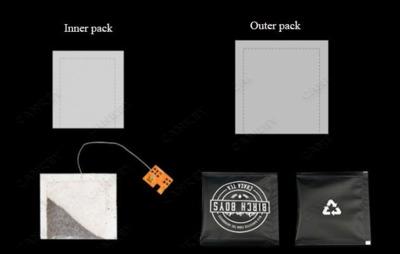
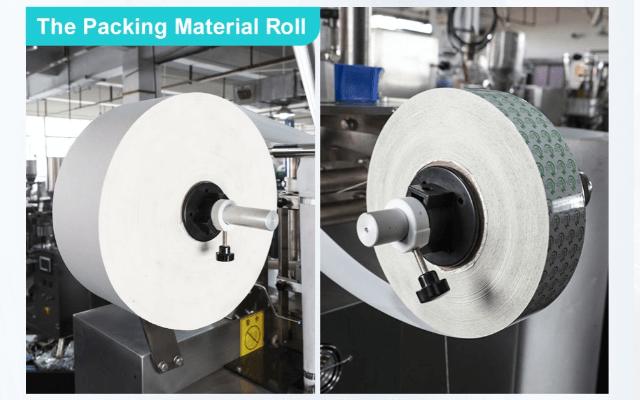
The YS-169 material-roll photograph helps distinguish physical web supplies. It does not identify their electrical properties or establish which material is retaining fragments. Do not infer conductivity from a printed pattern or from the appearance of a laminate. The actual supplied material remains the subject of the assessment, rather than a generic assumption about all tea packaging films.
Repeated contact can contribute to charge generation. The practical implication for a moving web is that its condition after one location may change following later contact and separation. An upstream treatment proposal should therefore be considered alongside the remaining material path before the reported sticking point.
Trace the relevant sequence conceptually: the web leaves its roll, meets guides or forming surfaces, passes pulling elements and separates again. Identify the last relevant contact before the unwanted retention. This is a way to locate the unresolved mechanism, not a claim that every roller generates problematic charge.
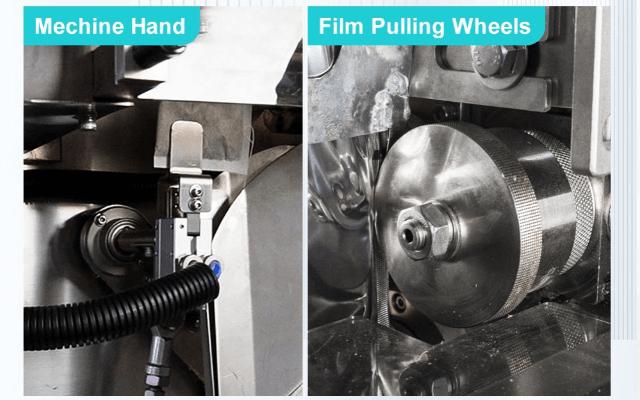
The YS-169 transfer and pulling-wheel views provide recognizable locations for that discussion. They show neither charge nor its magnitude, and they do not establish where a neutralizer belongs. If a proposal treats film before a later contact, its explanation must address the surface condition after that contact. Otherwise the proposed treatment and the actual sticking location remain disconnected.
A treatment location needs access to the relevant target. A broad, open web face presents a different access problem from a small exposed region beside a transfer assembly. A face hidden by a fold or another layer cannot simply be counted as treated because an adjacent face is accessible.
SMC describes bar, fan and nozzle arrangements for different applications, including broad surfaces and focused locations. Those categories help frame the geometry question. They do not select a suitable device for this tea application or establish compatibility with the offered machine.
Consider the full region where fragments are retained. A proposal addressing only the middle of a web leaves its edge coverage unresolved; one addressing an outer face leaves the hidden face unresolved. The machine maker must relate the proposed arrangement to the actual target and available access. No general device category guarantees complete coverage of a folded bag, moving envelope or obstructed surface.
Coverage also has a time dimension. For a target moving continuously through an accessible treatment region at a constant local speed, treated path length divided by target speed gives a screening estimate of exposure time. Both quantities must describe that same surface and use consistent units.
This is ordinary motion reasoning, not a tea-machine performance equation. It does not calculate charge decay, ion delivery or treatment of a hidden face. The estimate becomes misleading if the supposed treated length includes an obstructed area or a part of the path the relevant surface never occupies.
Intermittent movement needs its actual sequence considered. A pause adds potential exposure only while the target remains inside an effective treatment region. Waiting elsewhere contributes nothing to that target's treatment interval. Similarly, bag counts alone do not give local web speed without the corresponding motion information. No exposure duration or operating speed for the pictured YS-169 is established here.
A catalog's neutralization time belongs to its stated test. In the retrieved SMC IZS40/41/42 technical catalog, the graphs relate performance to target position and test conditions. The accompanying note identifies charged-plate data and limits its use to selection guidance because the target's material and size can change the result.
A moving packaging web is not automatically equivalent to that test plate. Its accessible area, motion and relationship to nearby surfaces require an application assessment. Selecting the fastest figure from a graph does not establish the time needed to prevent herbal fragments adhering to a particular film.
The catalog provides a reason to examine coverage and exposure together. It provides no measured charge, neutralization result or acceptable-pouch yield for this tea line. Use its conditional data to understand what the device supplier has characterized, then leave the unverified application result open. A catalog label cannot close that gap.
The YS-169 reference in the tea bag packaging machine range describes an inner filter bag transferred into an outer envelope. This creates distinct handling stages. Loose herbal tea retained during inner filling and a completed pouch retained at discharge concern different objects and locations.
Distinguishing these stages prevents a later symptom from automatically being assigned to the earlier web. A proposed treatment of the envelope surface does not establish treatment of loose tea or of a hidden inner-bag surface. Equally, an explanation for fragment retention during filling cannot by itself explain the behavior of a finished pouch on a belt.
The discharge photograph shows dark flat pouches on a green belt. It locates the downstream handover point but shows no sticking event or electrical measurement. Its pouch contents and production outcome are not established. Use the image to identify where a reported retention occurs, while preserving the distinction between that location and the earlier film path.
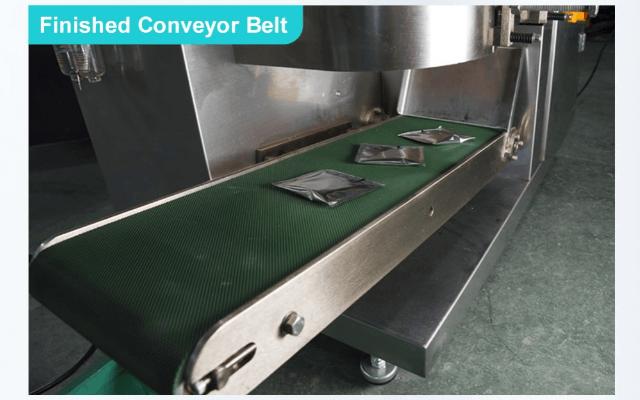
The purchase decision follows the physical explanation. A discharge-path issue on a connected conductor, charge retained on an insulating web and an interlocked leaf bridge call for different engineering responses. More than one cause may remain possible until the application is assessed.
| Identified condition | Relevant physical response | What remains unresolved |
|---|---|---|
| Charge associated with a conductive component | Equipment-maker assessment of that component's discharge path | Whether a separate insulating web also retains charge |
| Charge on an accessible insulating web face | Application-specific neutralization addressing that face after relevant contact | Actual coverage, exposure and effect on fragment retention |
| Charged face hidden or exposure interrupted | Review whether the proposed arrangement can reach the target | No effectiveness follows from device presence alone |
| Long leaves interlocked across a passage | Mechanical review of product shape and the available route | Neutralization does not enlarge the passage or remove the interlock |
| Retention associated with sticky product or deposits | Review the product and surface adhesion mechanism | Removing charge does not establish removal of stickiness |
Where the mechanism is still unknown, leave the accessory choice open. An ionizer may be relevant to confirmed insulating-web charge, but its name alone supplies no remedy for every delayed release. The useful outcome is an explanation connecting the affected object, its last contact and the proposed control location, with any remaining mechanical or adhesion problem still visible.
Why can tea cling when the frame is grounded? A conductive frame and an insulating web have different discharge behavior. The frame connection does not by itself neutralize the web. First establish which surface retains the tea and whether electrical attraction explains the symptom.
Can treatment before the pulling wheels be sufficient? Possibly, but later contact and separation need assessment. An upstream treatment point does not establish the web's condition after the remaining path. The photographs identify pulling elements without demonstrating that they generate charge.
Does a short catalog decay time prove suitability for herbal tea? It characterizes the stated test conditions and target. It does not establish treatment of the actual film face during its available exposure, or prove an effect on herbal-fragment retention. Those application questions remain separate.
Will neutralization release long leaves bridging a chute? It does not change the opening or undo a mechanical interlock. Leaves catching across a passage require a mechanical explanation. Charge may also be present, but addressing it alone does not establish that the obstruction is resolved.
Do these YS-169 photographs show an installed ionizer? They identify material rolls, transfer and pulling elements, and a discharge belt. They establish no fitted neutralizer, measured charge or successful treatment result. An accessory proposal must be assessed on its own application evidence.
Grounding can address connected conductors while leaving insulating-film charge unresolved. For herbal tea retention, locate the affected surface, consider the final relevant contact and examine whether a proposed treatment reaches that surface for useful exposure. Read catalog decay data within its test conditions. Keep mechanical bridging and stickiness as separate explanations, and distinguish inner filling from envelope transfer and discharge. The appropriate response depends on that physical diagnosis; neither a grounded frame nor an accessory name establishes the result.

YISEN MACHINERY - The ONE-STOP VFFS PACKING MACHINE SOLUTION SUPPLIER
 Tel: +8617350750975
 Email: info@vffspackingmachinery.com
 MP/WhatsApp: +8617350750975
 Manufacturer Address:Meixi Road, Tongan District, Xiamen,Fujian,China