

Hot Keyword:
Author:YISEN Pouch Packing Machine Manufacturer TIME:2026-11-24
A check sieve and a grading screen do different jobs before a spice powder packing machine. Check screening passes the intended product while retaining specified oversize. Grading deliberately separates material into defined size fractions. Decide which product stream the filler should receive before choosing the screen. Finer screening is not automatically preferable if it removes intended particles, blocks during operation or interrupts the powder supply.
Start with the material the packaging line is supposed to deliver. If a defined spice powder is already acceptable and the task is to intercept specified oversize, the duty is check screening. If production needs distinct fine and coarse fractions as separate outputs, it is a grading duty. The distinction precedes the choice of machine name.
Russell Finex publishes separate examples of these applications. Its dry-mango-powder case describes removing oversize before packaging, whereas its grading-spices case concerns a separation requirement. These examples support different purposes; they do not make one piece of screening equipment suitable for every spice.
Write the desired relationship between inlet and outlets. A checking operation generally seeks to preserve the intended product while intercepting material outside its definition. A grading operation expects separation to change the composition of the size distribution reaching each outlet. Confusing those purposes can produce a machine that operates as described while supplying the filler with the wrong product stream. The initial purchase decision is therefore about separation duty, not simply whether a sieve is included.
The word powder does not mean that every particle must be equally fine. A product may intentionally include recognizable fragments or a specified spread of sizes. Those particles should not become rejects merely because another powder runs through a finer screen. The commercial product definition must establish which material belongs in the accepted stream.
For a mixture, consider whether its components have different particle forms. A screening stage can preferentially retain a larger intended component while passing finer material. That possibility follows from size separation; it is not proof that a particular spice mixture has already changed. The question belongs in the product-to-screen comparison before the filler is assigned a new feed specification.
Describe the retained fraction as carefully as the passing fraction. Calling everything retained contamination can obscure legitimate product that the selected aperture excludes. Conversely, an oversize fraction should not be accepted simply because it shares the product's color. No universal mesh number resolves this distinction. It requires a defined spice duty and an explanation of how the proposed separator distinguishes the material streams.
A screen separates material according to the behavior of particles at its openings. Milling intentionally changes particle size through a different process. If an incoming spice is too coarse for the intended product, diverting its coarse fraction does not automatically produce the required amount of finished powder. It may merely reduce the passing quantity.
Soft agglomerates introduce another question. A cluster can behave differently from its constituent particles, but a screening claim does not explain whether the proposed process leaves it intact, separates it or changes it. Avoid assuming that an anti-blinding accessory is also a controlled size-reduction system. Its stated task should remain identifiable.
The buying consequence is a different equipment boundary. A line receiving material already within its particle specification needs a different explanation from one expected to create that specification. The site's YS-61F chili-spice reference identifies a powder-filling application, not an included grinder or sifter. Establish which upstream process supplies the required material rather than expecting the packer or an unspecified screen to correct an undefined incoming product.
Nominal screen area is not necessarily the area available throughout a run. Material can obstruct openings, changing the passing flow even though the installed screen has not changed. This is why a screening duty should be examined over its operating condition rather than described only by the separator's outside dimensions.
In Russell Finex's dry-mango-powder example, mesh blockage was part of the reported application problem. Its grading-spices account separately discusses oil-containing spices and a proposed deblinding accessory. These are supplier-specific examples of an operating constraint. They do not establish a universal accessory choice or a performance improvement for the buyer's spice.
Keep the two questions separate: which particles should pass, and whether the intended openings remain available while that material is processed. Choosing a coarser separation solely to restore flow could change the first answer. Adding a deblinding option also requires its own application explanation; the product name alone does not demonstrate compatibility. No ultrasonic frequency, mesh aperture, cleaning method or adjustment is prescribed by this comparison.

The filler receives the passing material, not the total amount presented to the separator. If part of the inlet becomes a retained fraction, those quantities differ. A quoted infeed capacity can therefore be insufficient information for deciding whether the downstream packing machine receives enough intended product.
Time variation also matters. A screen might pass material unevenly as its condition changes, while the packer requests portions intermittently. The receiving hopper and connection form the interface between those behaviors. This is a functional coordination question, not a recommendation for a particular buffer size, conveying arrangement or control setting.
Identify the flow reference in each supplier's description. Does it concern material entering the separator, accepted powder leaving it or product reaching the dosing hopper? A comparison that changes reference between those points can make unlike figures look interchangeable. The useful machinery decision is whether the accepted stream can supply the actual filling duty through the stated route. An empty separator demonstration or a nominal total feed figure cannot establish that relationship by itself.
Keep the basis of the flow description consistent as well. Material mass over a period and occupied powder volume over a period answer different questions. The latter depends on the material condition used to describe it. A dosing system specified by portions still needs an intelligible connection to the separator's passing stream. Merely placing two capacity figures beside each other does not establish that their units, material state and process locations are comparable.
Screening before a later transfer and screening near the receiving filler are different layouts. The first arrangement leaves another handling stage between separation and dosing. The second brings the separator closer to the packer, potentially changing the available height, access and connection. Neither location is automatically best for every installation.
Follow the accepted material after it leaves the screen. If it enters storage or another conveying device, that subsequent route belongs in the explanation of the filler supply. If separation sits above the hopper, its physical discharge and the receiving connection must be described together. A layout drawing should make those material destinations understandable without relying on a generic upstream-accessory symbol.
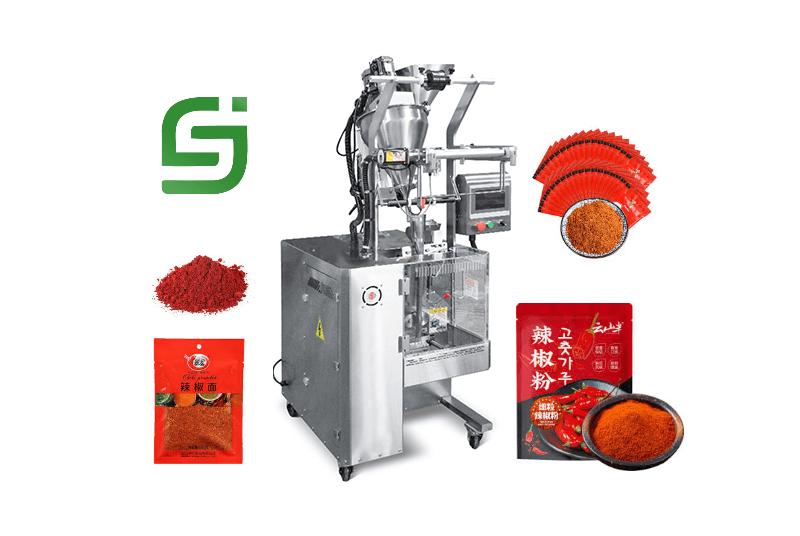
The original spice-machine outlet photograph helps identify the downstream powder-packing context. It contains no visible grading deck or check sieve. The powder packing machine category likewise does not establish which separation equipment is supplied. Any proposed screening location remains a separately defined part of the offered material route, rather than a capability inferred from the packer's product title.
A separation process produces material that does not follow the accepted outlet. That stream needs an identified destination in the line concept. Otherwise, the equipment discussion describes only the desired passing powder and leaves part of the actual material movement unexplained.
The destination depends on why the material was separated. An intentionally graded coarse fraction and oversize intercepted during checking are not equivalent categories. Automatic return to the inlet should not be assumed: returning material can change the meaning of the separation duty, especially if the original purpose was to keep that fraction out of the product supplied to packaging.
For purchasing, make the material distinction visible before comparing options. Which stream is the intended packer feed, which is another defined product and which requires a separate decision by the product owner? This is not a rework or disposal procedure, and no food-safety outcome is claimed. It is a complete account of the separator's outputs so that an apparently convenient connection does not contradict the purpose for which the machine was selected.
Changing the product can change what should pass. A separator used to check one fine powder should not silently become a grading device for a different spice mixture. The screen assigned to the next duty must remain linked to the intended material streams, rather than being treated as a generic interchangeable insert.
Equipment identity includes more than the surrounding machine frame. The actual screen and any application-specific accessory help define what the process does. A previous successful run on another spice does not establish that the same separation is appropriate when intended particle sizes or behavior differ. Keep the duty description available alongside the screen identification.
This makes a format discussion more useful than a promise of rapid change. The meaningful question is whether the new setup restores the intended separation function and supplies the correct passing material to the filler. No disassembly or sanitation method follows from that requirement. Supplier-supported procedures remain specific to the equipment, while the product owner defines which separated stream may enter the next packing campaign.

A short functional comparison helps prevent a sieve quotation from absorbing problems it does not actually address. The options below differ in purpose, not merely in the size of their openings.
| Observed requirement | Duty to discuss | Boundary to retain |
|---|---|---|
| Preserve an intended powder while intercepting defined oversize | Check screening | Accepted particles must remain part of the passing product |
| Produce distinct particle-size fractions | Grading | Each outlet has a defined product identity |
| Create finer particles from coarse incoming material | A separate size-reduction question | A screen alone does not establish the required transformation |
| Maintain flow when openings become obstructed | Application-specific blinding assessment | An accessory name does not establish sustained capacity |
The resulting specification should identify the intended separation, the passing stream and its connection to dosing. Avoid treating every upstream product issue as another reason to request a finer mesh.
Are check screening and grading the same operation? They have different purposes. Checking preserves an intended product while intercepting specified oversize; grading deliberately creates defined size fractions.
Will a finer screen always improve the filler feed? No. It can exclude intended particles or restrict passing flow. The chosen separation must match the spice specification.
Can a sieve replace a grinder? A size-separation function does not establish controlled milling. Coarse input and the required finished particle specification need a separate process explanation.
Does a deblinding accessory prove capacity for every spice? No. The cited cases concern particular materials and equipment. Another spice can present a different screening condition.
Does the YS-61F page establish an included screening machine? It supplies the spice-packing reference. The proposed sieve, its duty and its connection require their own description.
Select the separation duty before selecting an upstream accessory. Define the intended particles, the passing and retained streams, the effect of blinding and the route into the filler. That keeps check screening, grading and size reduction distinct, allowing the packing line to receive the product its dosing arrangement is meant to handle.

YISEN MACHINERY - The ONE-STOP VFFS PACKING MACHINE SOLUTION SUPPLIER
 Tel: +8617350750975
 Email: info@vffspackingmachinery.com
 MP/WhatsApp: +8617350750975
 Manufacturer Address:Meixi Road, Tongan District, Xiamen,Fujian,China